
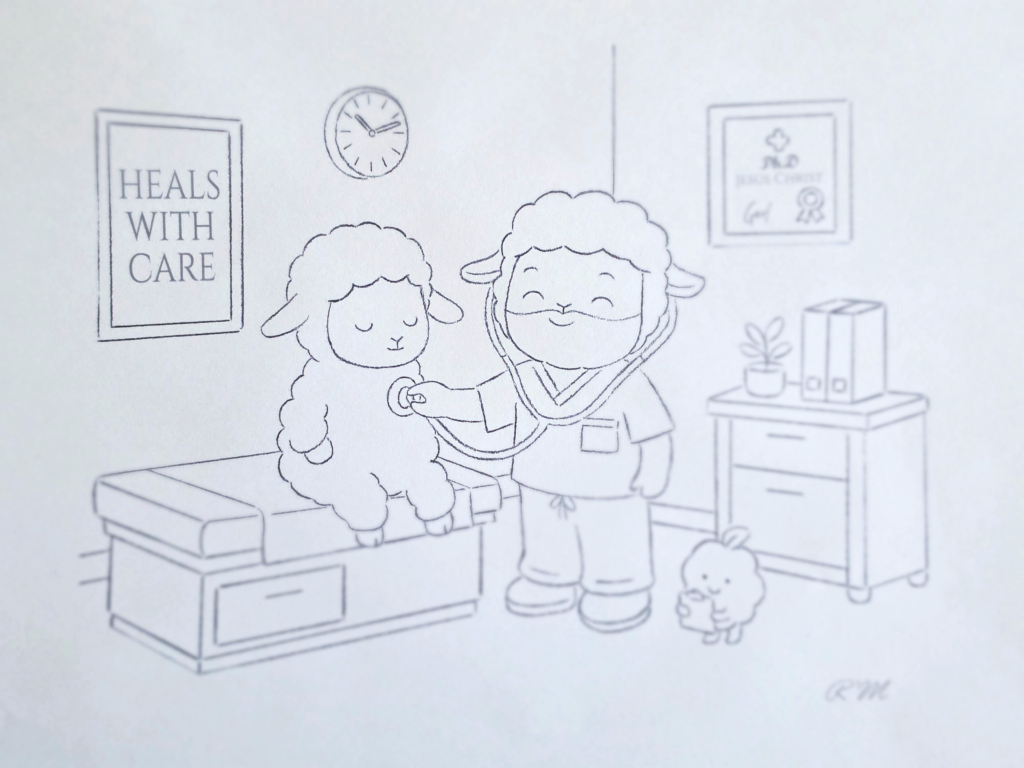
“When he went ashore he saw a great crowd, and he had compassion on them and healed their sick.”
—Matthew 14:14 (ESV)
Compassion
Contemporary medical professionals often express compassion through objective and clinical forms of care such as diagnosis, treatment, and medicine. By comparison, as our Great Physician, Matthew 14:14 portrays Jesus responding to the crowds with a profound and intense compassion, from which He personally heals the sick through His own presence and power. The Greek word splagchnízomai (pronounced splahngkh-NEE-zoh-my)1 portrays compassion not as a distant or detached concern, but a deep-seated, inward stirring of the heart.2 Jesus is moved within as He looks upon the crowd of over 5,000—men along with women and children. Among the vast crowd were the infirm, weakened by illness and affliction, together with countless friends and family members who shared in their suffering. They had brought “their sick”—this was not just an individual need, but a communal one.
In a parallel verse, Mark 6:34, we catch another glimpse of why Jesus was deeply stirred to compassion. The crowd was to him “like sheep without a shepherd”—vulnerable, without guidance or care. This echoes Numbers 27:17, where the imagery appears as Joshua is appointed to lead Israel after Moses. Without a leader, the Israelites would be left exposed—unable to stand in battle, unable to enter the promised land, and likely to scatter, wander, and live in fear. Moved by this reality, Jesus does not turn them away; instead, He begins to teach them many things concerning the Kingdom of God, tending not only to their physical needs but also to their deeper longing for truth and direction. Seen in this way, the flocking crowd gathering around Jesus paints a portrait of Him as the True Shepherd, whose presence offers guidance and leads them forward.
Jesus’ compassion becomes even more striking when we consider the context. He and His disciples had crossed the sea to withdraw—seeking rest, food, and a moment of quiet after long, unrelenting work. Yet the crowds followed and arrived ahead of them. What could have felt like a frustrating interruption in a moment of weariness was not met with irritation. Instead, the contrast makes Jesus’ compassion all the more evident, thereby reflecting in Him the very character of God revealed throughout the Scriptures. Exodus 34:6 (NLT) underscores this aspect of God’s nature, where the Lord speaks of Himself to Moses as “Yahweh! The LORD! The God of compassion and mercy!” The original sense of this compassion (raḥûm; pronounced rah-KHOOM)3 carries a familial depth—like the tender care of a mother for her child, or the deep concern felt for a brother or sister, as if bound by the same life. Jesus does not act apart from this—He reveals it. His care for the crowd, and for us, is personal, relational, and deeply rooted in that same kind of compassion.
Compassion → Healing
Accordingly, Jesus’ compassion (splagchnízomai) compels Him to act in response to the suffering and needs before Him. The word splagchnízomai is a verb that portrays not a passive feeling, but an active response expressed through merciful action. That is, Jesus does not remain in mere sympathy, but enters into compassion embodied through the concrete action of healing. He sees the need before anything is spoken, is deeply moved within, and then responds. The healing flows from Him, not as a detached act of power, but as an expression of His character.
Moreover, Jesus’ healing brings about a kind of care marked by restoration and wholeness. In Matthew 14:14, the word for “heal” comes from the Greek verb therapeúō (pronounced theh-rah-PYOO-oh),4 which carries the sense of attentive service that restores. From this same idea comes the English word “therapy,” though its modern usage often emphasizes process and treatment. Therapeúō, however, presents healing as proceeding from Jesus’ own attentive and relational presence. As the people approach Him from the surrounding crowd, Jesus draws near to each in turn, with healing flowing from one person to the next as His presence brings wholeness to the multitude. And while “heal” in this verse conveys the image of loving service and care repeatedly extended toward those in need, His healing remains complete and decisive. The entirety of the afflicted being cured bears witness to Jesus’ authority, bringing the emphasis back to Himself—the One who heals. In Him, what He does is inextricable from who He is.
The Great Physician draws near with compassion. He does not turn away, even when the moment feels like an interruption. Instead, Jesus meets the crowd’s needs with care—first through the depth of His healing, then by teaching them truths about the Kingdom of God, and finally with the abundant provision of food for all who had come to Him.5 From this, we see Jesus as the Compassionate Healer, neither distant nor restrained, but fully expressed through a presence that is both tender and powerful.
1. BDAG, s.v. “σπλαγχνίζομαι,” “have pity, feel sympathy.” ↩
2. In ancient thought, the inward parts, “bowels,” or σπλάγχνα (splágchna; pronounced SPLAHNGKH-nah), from which σπλαγχνίζομαι (splagchnízomai) is derived, were regarded as the seat of deep, visceral emotions. ↩
3. HALOT, s.v. “רַחוּם,” denoting deep, tender compassion, with associations to maternal care and womb imagery. ↩
4. BDAG, s.v. “θεραπεύω,” “serve” and “heal, restore.” ↩
5. Matthew 14:15–21 and its parallel accounts in Mark 6:35–44, Luke 9:12–17, and John 6:5–14 record the well-known miracle commonly referred to as the feeding of the five thousand. ↩